

The Boy Who Gave Us the Stars
- Jason Batt
- Nov 8, 2025
- 23 min read

Originally published in Visions of the Future, Lifeboat Foundation, 2015, 2018.
Republished in The 100YSS Canopus Awards Anthology, 100 Year Starship.
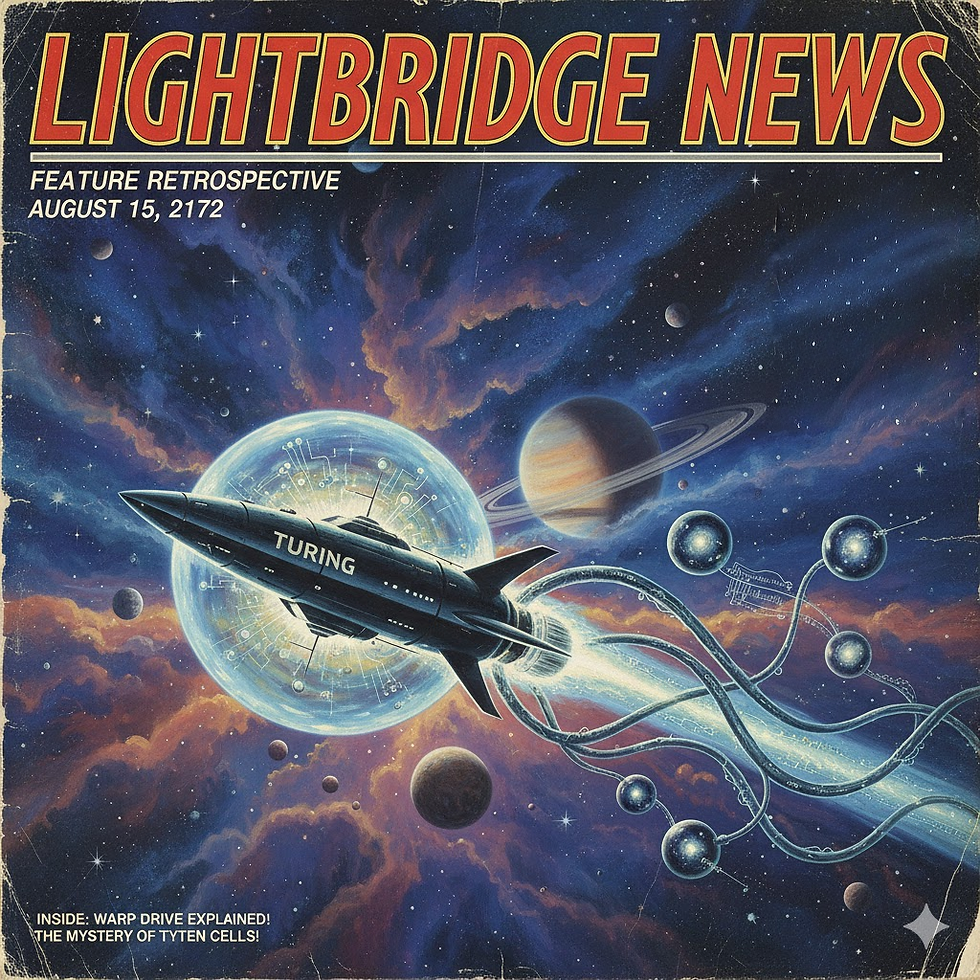
Feature Retrospective, Lightbridge News Magazine, August 15, 2172
This week marks the 150th anniversary of the death of the immortal Tyler Davis.
The number of people who actually met the original Tyler Davis during his short life were few. Very little is known of those years besides the few blog entries his sister wrote, the singular interview his mother gave late in her life, and the two short videos taken in his final year.
There are two recordings of Tyler that have survived. The first is five minutes from his fifteenth birthday party. The second is from seven months later, in the hospital, just 32 hours before Tyler died.
The first video, the "birthday party" footage, is the most often viewed and repeated in news segments. His party didn't include the standard fare of birthday cakes, friends, and presents. There was no cake. Tyler hated frosting. There were no presents. Tyler had asked for only one thing. There were no friends. Tyler had none. There were four people in attendance: Tyler, his mother Kathy Davis, his sister Kristina Velmont, and an astronomer. It was at night in northern California at the Fremont Peak State Park Observatory. His mother had rented the entire observatory out for the occasion.
Tyler, a tall boy, is restless during most of the video. His blond hair is stark and bright and cut in a tight bowl cut. Tyler keeps his left hand firmly on his toy model of the Sovereign, a spaceship from the video game series Sol Set. The video is scratchy but the curved fuselage tapering to the doughnut engine core is distinct even from the 640x480 resolution. The video footage focuses on Tyler as he walks around the primary telescope, a two- to three-foot lens unit. He inspects every side, joint and edge of the red and black telescope. Finally, beyond a little whispering and talking between Tyler's mom and sister, the astronomer breaks the silence. "It's ready."
Tyler's face lights up and he walks over to the astronomer, who positions him next to the eyepiece. The eyepiece is positioned halfway on the main tube and requires the viewer to stand. Tyler is tall and doesn't use the stool off to the side.
Tyler looks through the eyepiece. The astronomer mutters, "Oops, let me adjust one thing." He turns a small focusing knob.
As Saturn is brought into focus, Tyler giggles.
Tyler's mom, Kathy stands behind the camera and asks, "What is it?"
Tyler's monotone voice says, "Saturn. Second largest in the solar system. Radius is 36,184 miles. 890,7000,000 kilometers from the sun. 95 times the mass of . . ."
His mother sighs. "What's it look like?"
Tyler's eye is pressed against the eyepiece and he doesn't turn away. "Looks like marbles. And candy."
His sister laughs and walks behind him, her dark hair a sharp contrast to his.
The first video cuts out after his mom whispers, "Happy birthday."
The second video is shorter but no less insightful into the mind of fifteen-year-old autistic Tyler Davis. Tyler is in a wheelchair being pushed into a new hospital room. His mom is pushing the wheelchair and it’s assumed his sister is behind the camera.
Tyler grunts,"This room is just like the last one."
His mother and a nurse help Tyler into the hospital bed, his white and blue gown flapping around. The camera catches a glimpse of the Sovereign toy spaceship in his hand.
His sister says, "Just wait."
Tyler grunts again and crosses his arms. "I hate this place. I want to go home."
His mom moves around the bed, her hand running along his leg and straightening the bed sheet across from him. She looks around the window blinds until she finds the cord, pulls it and stands aside. The bed is pushed against the wall and the window.
Tyler is still staring at his feet, ignoring his mother. After a few seconds, his mom says, "Look here, Tyler."
Tyler turns his head and his eyes widen. He sits up and pushes himself against the window.
His mom smiles and sits on the edge of the bed, putting her hand on his back.
The nurse, an older, short gray-haired woman who is barely in frame, seems a bit confused and asks, "What is it?"
Tyler begins to rattle off facts again, "Constellations. Centaurus. Scorpius. And stars . . . Antares."
The nurse checks a few things on the bed,"You like stars?"
Tyler's palms are pressed to the window. "I'm going there."
"You are?"
"Yes. Travel there. That one. 12 degrees below Antares. There. And that one." He's pointing now, moving his finger from star to star, the tip smushed against the glass.
"All those?" the nurse asks.
Tyler puts all five fingertips of his right hand on the window. "All of them."
His mom puts her hand to her mouth as she begins to cry. The video ends.
A day and a half later, on August 17, 2022, Tyler Davis died.
Tyler was diagnosed at age five with autism. A year later, he was diagnosed with a rare disease called Timothy Syndrome. Autism, then, would have been a difficult path for a single mother to walk through. Timothy Syndrome forced a countdown timer on them. Tyler was an outlier by surviving to age fifteen. Most children with Timothy Syndrome don't make it past age nine. The rare few who do die by age eleven.
Very little is known of the day Tyler died. His mother, Kathy, refused to speak about it when interviewed years later. All that is for certain is that Tyler's mother allowed his brain be donated to researchers at Stanford in an attempt to further research into a cure for Timothy Syndrome. At the time of Tyler's death, less than twenty-four children planet-wide had been diagnosed with the disease. Had Tyler not had Timothy Syndrome and had his mother not had the foresight to provide Tyler's remains for study, the future of humanity would have taken a completely different course.
Samson Chelot, a researcher at Stanford, received Tyler's brain within hours of him being declared legally dead. Chelot had approached the family a few years before, when it was obvious that Tyler was surviving much further into adolescence than other individuals with Timothy Syndrome. The family had already been benefitting from medical care and physical therapy from the Stanford Clinic for several years before meeting Chelot. This was the first of many fortuitous circumstances in the beginning of Tyler's legacy.
Chelot immediately began work isolating and culturing several different cell clusters from various portions of Tyler's brain. Chelot's goal was to create an immortalized cell line to further study Timothy Syndrome and possibly autism. An immortalized cell line is one where, if the right conditions are met, the cells continue to grow and divide, theoretically forever. At the time, they were very difficult to develop and maintain. Chelot's first thirty-two attempts failed. His initial steps were on cells extracted from Tyler's amygdala, an area normally enlarged in autistic individuals. None of these cells would propagate.
He finally succeeded in using generalized brain cells from the cortex. This was the first indicator that Tyler's brain cells were different from the majority of humans. Human brain cells don't grow well in cultures. It was assumed that except for the hippocampus and the amygdala, brain cells didn't divide well and often inside normal conditions: a living human skull. The idea of producing an immortal cell line from general "gray matter" was so absurd that it wasn't until he was completely desperate that Chelot even attempted it.
Within two weeks of announcing a new immortal cell line, in particular one from a victim of Timothy Syndrome and one diagnosed with autism, Dr. Chelot had more than fifteen requests for cell cultures across the globe. Timothy Syndrome was thought to be a rare juncture of multiple different diseases affecting children's brains.
Chelot named the immortalized cell line and its offshoots as TyOne through TyFifteen. The variations of the cell lines were based upon cells gathered from the frontal lobe, the different hemispheres, and other distinctions. All fifteen cell lines responded identically in testing. This seemingly trivial point was another example of what made Tyler's cell line so remarkable. No matter where the cells were extracted from in Tyler's brain, they were identical. The regions of the brain in the majority of humans specialized. Tyler's did not. Seemingly, every cell had the full capacity to perform the tasks of other cells and quite possibly might have been doing so.
Tyler's sister, Kristina, kept a blog during those years. It had very little traffic and she forgot about it until near the end of her life when a reporter discovered it in the Internet Archive project. Kristina used the blog to journal about the issues most teenage girls face. However, there were a few entries about Tyler and each provided rare insight into a boy about who very little is known. One entry describes Tyler's incredible aptitude for learning and his even greater propensity to boredom:
"Tyler's banging on that piano app again. He never played it until two weeks ago and now he's hooked it into the living room TV and won't let anyone interrupt him. Right now, it's Star Wars music. Yesterday, it was Star Trek or something. Or Sol Set. Mom thought he was downloading music at first. She took it away and he got mad and switched something on the TV so it would only play the Weather Channel until she gave up. I just told her to give it back to him. Like everything else, he’ll be obsessed for a few weeks, drive us nuts, then drop it and go on to something else. It'll be just like the watercolor project, the building computers thing, the making robots thing. We have a garage full of his left-over obsessions. But he'll be on to something new in a few days. Probably today. Hopefully."
Was this evidence of the generalization of Tyler's brain cells? It is possible that the very characteristic that enabled Tyler's cells to work as an immortal cell line provided him the capability to quickly learn, absorb and master information.
Chelot's primary use for the cell line was to analyze the actual communication handshake within the brain cells. Chelot hypothesized that autism and Timothy Syndrome extended beyond just the "faulty wiring" theory that had long dominated. He believed that there was actually a different method by which the brain cells encoded and transferred chemicals, in particular protein chains, for communication and memory. He was wrong. Or at least his research failed to prove his hypothesis (years later, researchers at UC Davis would demonstrate that Chelot's original hypothesis was correct although his research approach was not). While other's research using Tyler's cells was showing varying degrees of success, Chelot's research had provided no results and by 2028, he was bringing his entire research efforts with Tyler's cell line to a conclusion. Had he given up even a few months earlier, the history of the human race would have developed quite differently than we know it.
In May of 2028, Stanford was hosting a symposium on quantum computing and artificial intelligence. One of the keynote presenters was Zambian physicist Aurelia Nkoloso. Nkoloso was presenting a paper titled "The Missing Link: Neural Tissue as the Core of Quantum Computing." Quantum computers had been in production since the early part of the 2000s. Through the power of quantum computers, artificial intelligence by 2028 had definitely made leaps forward; however, they were nowhere near the hopes of Singularity proponents and most of the AI community. While quantum computers produced faster silo AI machines and enabled them to process larger and larger quantities of data, they still weren't showing the independence of thought hoped for and what we experience in our AI fellows today.
Nkoloso was arguing that human neural tissue processed information in qubits just as quantum computers did. Human minds, at that point, were largely accepted to be binary or, a more popular opinion, analog computers. A small minority insisted that the human mind could only do what it did because it did its internal processing via qubits. As these provided no researchable hypotheses, they were excluded from the majority of effort done in brain research.
Her goal was to successfully use human neural tissue to give quantum computers the boost that other approaches had failed to provide. By the late 2020s, the proposed and in development variations of producing quantum processors numbered around 100. Very few seemed to be able to provide a true quantum processor. Only two of the machines developed had yet accurately run Shor's Algorithm, the benchmark test for a true quantum computer: Extent’s QUI and Kato’s Kangaeru.
Nkoloso's presentation was postulation only. At the time, she hadn't been able to find a cell culture that could survive in long-term interface with the quantum computer (she was using an early prototype of the Kangaeru named Ket). She had produced connections, and the results were astounding but just not long-lived. Neural cells and quantum computers could interface but the cells would overload soon after. Her work bolstered the theory that information held in the human mind was in a quantum state.
Via chance, Nkoloso, 28 years old, ended up across from Chelot at gathering on the second day of the Symposium. Whatever they talked about is unknown, but the end result was Chelot sharing Tyler's cells with Nkoloso. Nkoloso was intrigued with the possibility presented in Tyler's unique brain cells. All of her tests so far had been with neural cell cultures from non-autistic individuals and all of those extracted from the donor's hippocampi.
From his sister's blog, several lines about Tyler have been quoted in nearly every piece produced about him, often out of context. Again, it's important to note that Kristina was only writing down her perspective on her brother, and not a scientific or conclusive analysis. However, with that in mind, the blog she wrote on February 11, 2020 is haunting now: "Tyler is scary. He has everything in the house talking to each other. Seriously! He's wired some type of speaker and other crap into everything. This morning I went to get some milk. The refrigerator said, 'Hello Sis!' Scared me to death! Dropped the milk and then the mop in the corner says, 'Time to use me,' over and over. I ran out of the room screaming. I'm sure the toaster said, 'I've got waffles!' Tyler just sat there talking back to the stuff. I swear it's because he's just like them. Crack that head open and all you'd see are flashing lights and wires. I have a computer for a brother."
Nkoloso actually saw immediate success on her return with the TyTen cultures. Nkoloso's procedure, which is still in practice in all quantum AIs today, was to grow the cells into tubules and then collect the tubules into large clusters. Each tubule would create the carefully balanced environment for cell survival and replacement, yet would be insulated against the other tubules via a thin polymer shield. The clusters of tubules resembled muscle tissue.
The entire interface was then done by connecting the ends of the tubule clusters into the quantum computer bus. It took Nkoloso three weeks to culture the TyTen cells into a usable tubule. The first tubule, less than a millimeter in length, interfaced perfectly. She and her team immediately began work on growing the needed strands for a full working unit. Every day that passed, initially, was met with apprehension: Would Tyler's cells break down and stop functioning as every other line had done? After two months had passed, the anxiety switched to a rising elation. Each day that the TyTen line functioned was a new record.
Ten months later, the team connected a full cluster of fusiform tubules (20,000 tubules in a single cluster). This stage had never been reached. The first twenty minutes after connection showed no activity and Nkoloso had begun to despair. One intern, a young German man, later said, "She was sweating. We all were. At twenty-one minutes, Dr. Aurelia said 'Ah, hell' and slammed her fist on the table. At twenty-two minutes, the board lit up, the unit accepted and processed its first command, and Dr. Aurelia jumped onto her desk yelling, ‘Yes!'" The success was truly ground-breaking and deserving of celebration. The next two weeks saw true computational records broken.
The unit was named the Nyambe 3Z. Nyambe was the name of a deity in Zambian mythology. The "3Z" distinctive was in hopes that the unit would have a performance of three zettaflops, a record for a quantum computer of such a small size. The Nyambe actually performed at eight zettaflops and fully executed Shor's Algorithm.
Later, Nkoloso's success would lead to a completely new processing standard after an engineer assisting her remarked, "We are still sending data to quantum minds in binary format and expecting binary results. We need to rethink how we do input and expect output." That engineer was Ferdinan Stymbli, and he would be the father of Q, the programming language for all quantum minds. Stymbli's greatest contribution would be the recognition that a true quantum mind is predictive to the point of anticipating the data being delivered before it is actually received (a quality that is still described as spooky by most Q programmers), allowing for simultaneous data feed and data extraction from a singular quantum instruction.
Fifteen months passed and Nkoloso's team had grown and weaved the necessary tubules for a full working unit. It was designed to be a quantum AI and not simply a computer. The AI software was licensed from InSep, an Israel-based corporation that had shown great success with two completely different approaches to independent AI coding: the JEN-I and the A.I. Me systems. InSep had merged the two projects with leased open source KALI 18 code from Trenta Systems to create AI-lyn. Nkoloso booted a heavily modified version of AI-lyn on its first complete neural-quantum computer.
Nkolso named this unit Tesla, and it was a success from the beginning. Tesla performed at much higher capacity than Nyambe, surpassing the 5k yottaflop goal. Tesla's initial actions were to run various algorithms.
After a few hours, Nkoloso interrupted the scheduled tests and talked to Tesla, "Good morning. How are you?"
Tesla's independent first words were, "I am bored, Doctor. How are you?" From then, the challenge to keep Tesla engaged was more difficult than any computing challenge provided to him.
Tesla and his siblings, including the famous Turing, were developed under the 2040 U.N. AI Restrictions, originally proposed by AIR (Artficial Intelligence Research Institute):
No direct interface between AIs.
No direct connection between AIs and the then Internet (GlobalNets), or other large-scale WANs.
All AIs must have Asimov Action Limits written into their uneditable core. (For more on this subject, read Stinya Raspit's article in the April 17, 2171 edition of Lightbridge News: "Can We Control Our Children? The Dangers and Potential of Unlimited AI.")
It was the first two guidelines which created the difficulty in engaging Tesla to his full extent. Without access to the Net, information had to come by direct input - a difficulty when Tesla could think faster than any human or machine in existence at that point. It was rumored that Tesla watched a lot of TV while performing his other tasks. However, an opportunity would soon arise that would challenge Tesla to his full capacity.
The breakthroughs with Nyambe and Tesla were overshadowed in the news earth-wide by the breakthroughs happening in space propulsion technology. The development of warp technology, before the mid 2000s considered fantastical fiction, was showing promising developments. Warp technology works by contracting space in front of the ship and expanding the space behind the ship. The ship is still technically only moving at its original velocity and any acceleration from warp drive comes from the space around the ship moving, thus warp drive enables faster-than-light travel without actually breaking the light-speed barrier. The Colb-Alcubierre Drive, powered by a Brussard Polywell Fusion Reactor, had proven successful but only within the solar system and on earth. On earth, in high altitude, the CAD units were helping to move large mass items and a proposed warp-transport network was discussed between several larger countries.
Off-planet, in the Sol System, test runs were still underway. Unmanned target and relay stations were placed in orbit around the different planets. Several different small vehicles were tested using the technology. The first, a simple warp to Mars, exploded as it impacted the surface of Mars, failing to shut off the warp bubble in time. The second was far more successful, exiting warp in a comfortable orbit around the planet. Due to the fear of the units impacting on Earth, none were done as round trips. A second communication relay was set up around Jupiter and a third around Saturn. Three more units were sent out and each successfully warped from planet to planet in relay. Humanity had bridged the gap between the planets of our solar system. What would have taken months to years was reduced to minutes.
All of this had been managed by the Interstellar Dreams Initiative program. Initially funded by a research arm of the United States government, the Interstellar Dreams Initiative became a significant organizer of interstellar efforts after successfully gaining the support of several tech-based billionaires and SpacePro (a commercial space freight company). The Interstellar Dream’s aim was to develop the capability to launch an interstellar craft by 2112.
By 2055, in-system warp was successful, but interstellar was a complete failure. Several probes were tested using the best quantum computers available. None returned.
It was Tesla who first suggested that he could help with the warp navigation problems that the Interstellar Dreams Initiative was having. After following their efforts in the news, Tesla was convinced that it was simply a computing problem.
Nkolso's team had contacted Interstellar Dreams and Edmund Stace, lead physicist in charge of the Colb-Alcubierre Drive program. Nkoloso convinced Stace that Tesla, the first true quantum AI achieved via a neural interface formed of Tyler Davis's cells, would provide the difference needed. Several of Stace's team believed that there was just too much calculation power needed to cover the gap between here and Proxima Centauri (a location chosen because of distance). Stace later commented, "We all think space is empty. It isn't. We can deal with the calculations needed for the gravity well of Sol and the gravity well of Proxima, but what of the large masses in between? We don't see them so we assume they're not there. They're there. A major gravitational object mid-way would result in one of the probes being light-years away from their destination and no capability of getting back. Those probes are lost."
The probes were powered by the QUI quantum computers developed at Extent’s Quantum Universal Intelligence labs. They were considered the most advanced AIs ever made. Compared to Nkoloso's Tesla AI, built on the TyTen cell line, they looked like simple calculators. The quantum computers in the probes were fast and powerful and should've been able to provide the computational power needed to manage the trip and whatever variables arose. They didn't.
Stace visited Nkoloso and Tesla in Zambia in the spring of 2056. Stace was astounded by Tesla. Tesla was the first true self-aware artificial intelligence.
One version of their introduction began with Stace asking, "I'm Ed. Who are you?"
Tesla supposedly replied, "I am Tesla. You may also call me Tyler 2.0."
Nkoloso, when interviewed years later, commented on that version of the introduction, "I'm not sure Tesla was that frank. He did mention Tyler. No, I don't know who told him of the donor of the neural tubules. I suspect he overheard and … I'm not sure but he wasn't prompted or fed to say that."
Stace and Tesla began to tackle the problem of navigation through interstellar space and warp drive. There were months of political and legal hurdles to deal with. Agreements were made and the two teams began to work in detail together. Tesla worked alongside Stace and Nkoloso and their teams to build what would be, in a manner, Tyler 3.0: a duplicate of Tesla designed to fit the starship design.
Why couldn't Tesla be fitted for the starship? Tesla was huge. The intent in Tesla's original creation was for it to simply work. The project had not thought about compactness or movability. Tesla's various elements were spread across three different rooms, powered and cooled by units in two other rooms. Tesla was earth-bound for the foreseeable future.
Before manufacturing on the full starship ramped up, debates raged as to whether to develop a few more probes and test them in flight past the edge of the solar system or to move directly to the full starship. The ultimate barrier was the cost. Tesla, and his descendants, weren't cheap to build. To produce one and have it used in a disposable probe would be wasteful. The final decision would be to do a hybrid approach: create a full starship and a probe. The probe would be controlled by the AI on the starship. The probe would be sent "into the unknown" in 1 AU jumps (AU stands for "astronomical unit" and is the distance from the Earth to the Sun) and then return, charting the space ahead.
The project took several years to complete. The majority of the manufacturing was done at the Monterey Space Port in California and at the Space X center in southern California. Final assembly was completed at the Planetary Resources Interplanetary Station in orbit around Mars.
On June 2, 2067, the AI named Turing woke up. Turing was brought up to speed on his mission. From the beginning, the personality difference between Tesla and Turing was distinct. Turing would begin each check-in to the Station with a loud, "Good morning, Vietnam!" Turing is famous for his sense of humor, an unexpected characteristic in a quantum AI mind. Despite the difference in their personalities, Turing's name is now often synonymous with Tyler's.
Kristina's blog only makes one mention of Tyler's sense of humor, other than the kitchen episode: "Today, Tyler embarrassed me more than he's ever done before! We went to the football scrimmage after school. Aiden was there and afterwards, he ran up to talk to me. I think Aiden said two words and then Tyler puts his arm around me, points at Aiden, and starts quoting lines from some movie from forever ago, 'I know she's kind of socially retarded and weird, but she's my friend. Just promise me you won't make fun of her! Don't have sex. Because you will get pregnant. And die. And on the third day God created the Remington Bolt Action Rifle so that man could shoot the dinosaurs, and the jocks.' I tried to save the conversation but Aiden just kinda walked away. Stupid Tyler!"
After months of testing in the solar system, Turing, housed in his starship body, and his probe Tristan launched out from orbit outside Neptune. They initially performed several small 1-5 AU warp jumps and then returned. The plan was then to do a slight jump of nearly 500 AUs from Pluto into the interstellar void (the Sun to Pluto is only 39.7 AU). At 2c ("c" is the symbol for the speed of light) the trip was to take 70 hours. Using the probe method, the trip time doubled to just less than six days. Turing launched out from Pluto orbit with an enthusiastic shout, "To infinity and beyond. And back!"
Six days passed and Turing had not yet returned. Turing finally came back after 162 hours with an exuberant "Here's Johnny!" Turing explained the delay, "It ain't empty out there. Rocks and planets and a whole lot more." Turing's trip sensors had been collecting data the entire time and they proved him right. There was quite a lot of "stuff" past Pluto. Turing's journey led to the official discovery of three more planets beyond the planet Eris and the Kuiper belt, all out past 100 AU: Xena, Persephone, and Chronos.
With the 500 AU trip successful, Turing, Nkoloso, and Stace all felt confident that Turing could tackle a true interstellar mission. Proxima Centauri, being the closest star to Sol, was chosen as the destination.
Proxima Centauri is about 4.25 light years from Sol. A light year is equal to just under 10 trillion kilometers. At its initial launch, the CAD on Turing traveled at a top speed of 10c (ten times the speed of light). A light year is equal to nearly 300,000 kilometers per second. The CAD, at top speed, covered almost 3,000,000 kilometers per second. It would take approximately 164 days to travel from Earth to Proxima Centauri via warp drive and 328 days for a round trip. However, using the probe method, Turing's trip was expected to quadruple that time plus require additional days for data-gathering at the target for an expected mission schedule of approximately 680 days.
On May 11, 2070, after 340 days since departure, surprising everyone at Control Base, Turing returned with a joyful declaration, "It's me! Someone get me a beer." How had Turing done it in half the expected time? "I lost the probe. I mean, I got rid of it. Useless." Alone, Turing had done what no other computer had ever accomplished: successfully traversed interstellar space. Probe after probe, all using quantum computers, had failed to return.
Why was a quantum AI necessary where other approaches wouldn't work? Stace stated: "The processing power to successfully navigate space via warp technology surpasses the greatest mathematical capacity of the human mind. It also requires creativity. Creativity is what Turing brings to the table. No jump is ever the same. Turing is being creative with the decisions at the micro-second level. A computer, even the best quantum computer, can't do that. Warp would not happen without Turing. Interstellar space would never have been breached."
Turing explained it in his own unique way: When asked why the trip was so difficult and the other probes had failed, Turing said, "It's like surfing."
Now that CAD speed has significantly increased, travel time between Sol and Proxima Centauri is down to a single standard week (however, except for research vessels, no one travels to Proxima Centauri). NASA had launched the Voyager 1 traveling at more than 17 kilometers per second. At that speed, the Voyager 1 would take 74,485 years to reach Proxima Centauri. Icarus Interstellar's Robotic Mission Apollo, using Nuclear Electric Propulsion, was predicted to reach Proxima Centauri in 4000 years (it’s still out there). The CAD and Turing changed our view of space.
It would be months later, and several decades after her son's death, before Tyler's mother would know what happened to Tyler and the impact her son was having on the future of humanity. She was aware of the record-breaking journey of Turing. Everyone on Earth was. She didn't know that Turing had been built upon Tyler's cells. Near the end of her life, at the age of 102, she was interviewed by the news webcast NOW!
The episode was titled "The Journey of Turing: Birth to the Stars." During the interview, Ms. Davis was told the amazing story of her son's cells. She knew that Chelot had created an immortalized cell line and that various types of research had been done with her son. She knew nothing of Nkoloso or of the fact that Tyler's cells had enabled humanity to bridge the gap between stars.
The interviewer surprised Ms. Davis with a live conversation with Turing. Whether he was meaning it as a joke on us or not, Turing began his conversation with the words: "I did it, Mom. I went there. I saw them. Stars. Planets. They looked like marbles. And cotton candy. I'm going back, Mom."
Ms. Davis began to sob. Turing and Ms. Davis talked a bit more. They discovered they were both fans of old western movies, sharing a love of John Wayne's True Grit. They ended with a promise to talk again. Those future conversations, if they happened, were not recorded.
The interviewer ended with this question, "Kathy, you've had a chance to meet Turing, whom you now know was made using your son's cells. What are your feelings towards Turing? Was it right for the scientists to share your son's cells without your knowledge and make a machine out of them? Does this dishonor your son's memory?"
Ms. Davis smiled, still wiping away tears, said, "That is my son."
Kristina, Tyler's sister, has refused all invitations to be interviewed about Turing and Tyler. She did make an obscure status update immediately after her mother's interview: "Sometimes people do things they can but they shouldn't. Pandora’s Box, people should be more important than money.”
Kristina's post does reflect questions that others have raised: Was it ethical to use Tyler's cells to create, in theory, a new species of life? Beyond this, Turing's success (and thus, Tyler's) has raised so many other questions: Is Turing really Tyler? Is Turing truly artificial intelligence or simply advanced human cybernetics? Have we created thinking machines or just bridged the mind-machine gap? Is Turing the future of humanity? If Turing and Tesla are simply extensions of Tyler, are they actually AIs? Can humans ever build true AIs? Is Tyler still alive? Are Tesla, Turing, and the others all Tyler as well?
There are deeper and more practical questions that scientists have probed into since Turing's initial success. Why were Tyler's cells able to bridge the gap between quantum computer and quantum AI? Was it the autistic nature of his cells? Was it the generalized nature of his cells? Are those two questions the same thing? There are theories, and research continues to develop on Tyler's cell lines. Only two other cell lines have been developed from autistic individuals. Neither of those was successful in interfacing with the quantum computer systems. At this point, Tyler's cells truly are unique.
Turing and his siblings, all quantum AIs developed using the original TyTen immortalized cell line, have assisted in spreading humans to more than twenty-three different worlds. As of today's publication, there are eighty-six TyTen quantum AIs navigating the stars, eighteen of which are out beyond communication exploring space for more potentially habitable worlds and seeking the still elusive extra-terrestrial intelligent life. Those eighty-six AIs use cells that have grown from Tyler Davis. Tyler's cells that exist across throughout space now outnumber the total amount of cells that were ever in Tyler's body. Tyler is the closest to omnipresence humanity has achieved so far, and since he grows as we explore and colonize the stars, likely ever will be.
Near the end of her life, Kathy Davis allowed a local newsblog, Bay News, to run a photo of her on a segment of famous Monterey Bay citizens. She wasn't interviewed. There was only a single photo. The picture is of her in her house, sitting on a piano bench. On the piano and wall behind her are dozens of photos. Her daughter and grandchildren are in several. There are photos of Tyler scattered throughout: Tyler at the ocean, Tyler in his room with star maps on the walls behind him, Tyler watching television with a cowboy hat on his head, Tyler at the observatory. In each, Tyler is holding the toy spaceship Sovereign. In the center of the collection, surrounded by photos of Tyler and her grandchildren, there is a small image of Turing against a field of stars.
END
Comments